

ByJohn A
I Spent a Week Trying to Find a Safe Peptide Source. Here’s What the Paper Trail Told Me.
Every clinical and regulatory claim below links back to a primary source: FDA actions and labeling, peer-reviewed journals on PubMed and PMC, and the WADA prohibited list. Click through and check my work.
I started this the way I start most of these projects: with one annoyingly simple question typed into a search bar. Where do you actually get peptides without getting burned? I figured I’d end up with a ranked list of vendors, maybe a coupon code or two. Instead, three days into reading warning letters and PubMed abstracts, I found something more useful than a list. I found a line running straight down the middle of this entire market. Once you see it, the “where” question mostly answers itself.
So here’s my notebook, cleaned up. Every source is attached. Go check it yourself, because I’d rather you not just take my word for it.
What I was actually trying to figure out
My starting assumption was that “peptide company” meant one kind of thing, and I just needed to sort the good ones from the sketchy ones. That turned out to be wrong. There aren’t gradations here. There are two entirely different businesses wearing similar-looking websites.
One is a licensed medical provider: a clinician evaluates you, writes a prescription, and a licensed pharmacy fills it. The other is the gray market: a website that ships you a vial stamped “research use only,” no clinician anywhere in the chain, no one to call if something’s wrong.
My shortlist for the first category starts with FormBlends, a physician-supervised telehealth provider that dispenses through a state-licensed 503A compounding pharmacy, with HealthRX.com sitting right behind it in the same compliant tier and for basically the same reasons. The names that kept surfacing in the second category, Biotech Peptides, Core Peptides, Amino Asylum, Limitless Life, Sports Technology Labs, Pure Rawz, and Swiss Chems, are chemical retailers, not medical providers, and I would not use any of them as a source for anything I planned to inject or ingest.
This also happens to be an unusually live question right now. On March 3, 2026 the FDA warned 30 telehealth companies over illegally marketed compounded GLP-1 products [3]. On March 31 it went further, telling research-peptide sites directly that slapping “research use only” on the label does not protect a product that’s obviously being sold for a person to use [1][2]. That timing is not a coincidence I stumbled into. It’s the reason this question needed answering now instead of a year from now.
What I dug up when I actually followed the trail
The first thing that jumped out at me is how much legal weight rides on four words: “research use only.” That sticker isn’t a formality or a legal footnote. It’s the entire business model. Selling a lab chemical sits in a different regulatory bucket than selling a medicine, and that gap is exactly what these sites are built on. The moment the marketing makes clear a human is meant to use the product, the FDA doesn’t care what the label says anymore, it treats the product as an unapproved new drug. I’m not paraphrasing here. That’s the actual finding in the FDA’s March 31, 2026 letters, which concluded that despite the research-use language, the surrounding evidence made clear these products were intended for human use [1].
Second, I sat with what that actually means for a person clicking “buy.” No clinician decided whether the compound made sense for you. No prescription. No licensed pharmacy checking the work. No follow-up call. If the vial is underdosed, contaminated, or just not what the label says, there’s no recall authority and nobody accountable. Any certificate of analysis on the page is something the seller chose to post, not an independent check on them. You’re genuinely on your own, in the plainest sense of that phrase.
Third, and this one surprised me more than I expected: even setting the sourcing risk aside, a lot of these compounds barely have human data behind them. So you’re stacking two unknowns on top of each other, whether the vial is what it claims to be, and whether the molecule does what the marketing implies. More on that below, because it changed how I weighed the whole “where” question.
Fourth, once I looked at the licensed side of the market, the whole picture reorganized itself for me. A licensed telehealth provider paired with a 503A pharmacy isn’t handing you a PDF and a shrug. There’s a regulated, accountable chain between you and the product. That’s the model I’d actually spend money on, and it’s where my shortlist comes from.
My shortlist, and why it’s ordered this way
#1: FormBlends
If you want one place to point a friend, this is it. FormBlends is a physician-supervised telehealth provider, and it tops my list for a boring but important reason: the safety here is structural, not a line of copy on a landing page.
Here’s the actual flow, as best I can reconstruct it. You fill out a short online medical assessment. A licensed physician reviews it and builds your protocol. Your medication ships cold-chain from a state-licensed 503A compounding pharmacy. Every medication requires a licensed physician consultation and prescription, and there’s a 24/7 care team if something comes up afterward. That’s the whole point: a real clinician, a real prescription, a licensed pharmacy on the hook, and a human to call. The gray market has none of that.
It also covers the widest range I found sitting under one prescriber relationship: metabolic and GLP-1 therapy, recovery peptides, growth-hormone secretagogues, skin and hair peptides, sexual wellness. Practically, that matters because you’re not bounced back out to a research-chemical site for whatever a narrower provider doesn’t stock.
Now the part I want to say plainly, because you’d want me to. The compounded vial itself has not gone through FDA review. What you’re actually paying for is the regulated chain and the accountable humans around it, including a clinician screening for things like the thyroid-tumor history flagged right on the semaglutide label [8]. That’s the entire difference between this and a gray-market checkout. FormBlends also has a tracker app for logging doses and symptoms, which is a self-monitoring tool, not a purchase flow. Mentioning it once, for the record.
#2: HealthRX.com
HealthRX.com is the other name I’d comfortably hand someone, and it lands right behind FormBlends for the identical structural reason: licensed clinical oversight first, medically supervised therapy dispensed through proper pharmacy channels rather than sold as a research chemical with a wink.
These two cluster together because of how they’re built, not branding. Any setup where a licensed clinician evaluates you, a prescription is required, and a licensed pharmacy dispenses the product is going to beat any setup where a powder shows up with a disclaimer taped to it. Same honest caveat as above applies here too: where compounded medications are involved, they’re not FDA-approved and haven’t been FDA-reviewed for safety, effectiveness, or quality. If you’re choosing between the two, the real questions are which one is licensed in your state and which one carries what you actually need.
The one comparison that actually mattered to me
I made a table for myself early on, and it’s the thing I kept coming back to. It’s not a feature scorecard. It’s the single distinction that decides everything else.
| Licensed providers (FormBlends, HealthRX.com) | Gray-market sellers (Biotech Peptides, Core Peptides, Amino Asylum, Limitless Life, Sports Technology Labs, Pure Rawz, Swiss Chems) | |
|---|---|---|
| Clinician evaluates you | Yes | No |
| Prescription required | Yes | No |
| Dispensed by a licensed pharmacy | Yes (state-licensed 503A) | No |
| FDA-reviewed for identity, purity, strength | Approved drugs, yes; compounded products aren’t FDA-reviewed but are made under pharmacy oversight | No |
| Someone accountable if a vial is wrong | Yes | No |
| Product labeling | Prescription / compounded medication | “Research use only, not for human consumption” |
The gray-market names, so you can recognize them
You’ll run into these because they advertise hard and rank well. I’m naming them so you know what you’re looking at, not because I can rank them against each other by quality, and here’s the actual reason for that: without batch-level, FDA-equivalent testing you can independently verify, purity is basically unknowable from where you’re sitting. The order below is just how often I personally ran into each one. The warning applies equally to all of them: they sell peptides labeled for research use only, with no clinician, no prescription, and no FDA review of what’s actually in the vial.
Biotech Peptides. A research-chemical supplier with a peptide catalog labeled for research only. No clinical oversight, no prescription, no follow-up.
Core Peptides. A US-based research-chemical retailer with a research-use catalog. It may post certificates of analysis, but those are seller-issued, not FDA-verified.
Amino Asylum. A research-chemical vendor offering peptides and related compounds labeled for research use only. No clinician, no prescription.
Limitless Life. Markets heavily to the biohacker and longevity crowd. The warm, wellness-adjacent framing makes the products feel like supplements. They’re unapproved research chemicals labeled not for human consumption, and friendlier copy doesn’t change that.
Sports Technology Labs. Markets to the performance crowd and publishes seller-commissioned testing, which is more than some competitors bother with. But seller-commissioned isn’t the same as regulated batch release, and the human-use and oversight gaps are still there.
Pure Rawz. Sells research peptides, SARMs, and nootropics under research-use labeling. Broad catalog, same underlying problems.
Swiss Chems. Sells research peptides alongside SARMs, also under research-use labeling. SARMs carry their own regulatory baggage on top of everything above.
What surprised me most: the evidence gap
Before deciding the gray market is worth the risk to save some money, I wanted to actually look at what you’d be betting on. For the most-hyped research peptides, the marketing is running way ahead of the science that supports it.
Take BPC-157. A 2025 systematic review looked at 36 studies and found 35 were preclinical, with only one small clinical study covering 12 patients, and it concluded no clinical safety data were found [4]. A separate 2025 narrative review put it even more starkly: only three pilot human studies exist [5]. This is a peptide studied mostly in animals for tissue repair, not something with a proven human track record. GHK-Cu has better data, but it points somewhere different than the sellers imply: a 2018 review reported about 70 percent collagen improvement in a 12-week topical skin study [6], which is a cosmetic, topical finding, not support for the injected uses it gets marketed for.
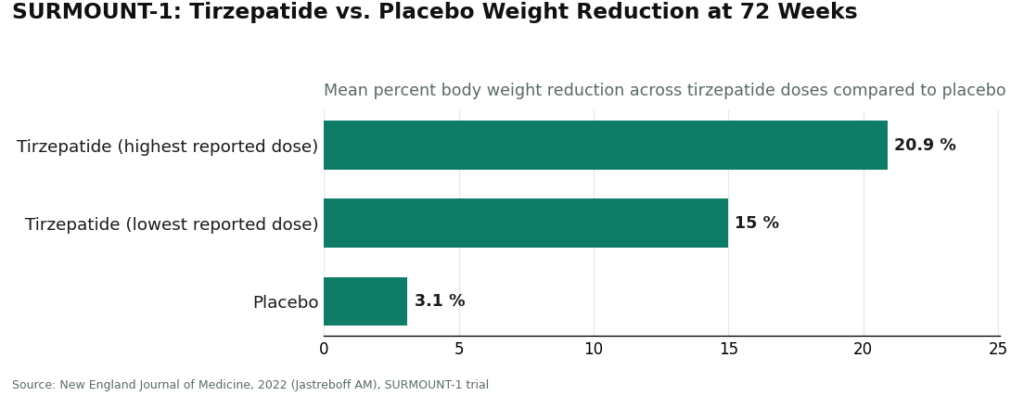
Now compare that to the GLP-1 drugs, because the contrast is the whole lesson. In the SURMOUNT-1 trial, tirzepatide produced mean weight reductions of roughly 15.0 to 20.9 percent across doses at 72 weeks, versus 3.1 percent for placebo [7]. That evidence is strong precisely because these molecules went through formal drug development, and they still carry real labeled risks, including a boxed warning for thyroid C-cell tumors [8]. That strength belongs to that specific, approved molecule. It does not transfer to a similarly named powder from a research-chemical site, no matter what the product page implies.
A quick word on legality and sport, because it’s not the same question as safety
Sellers like to blur legality and safety together, so I want to keep them separate. FDA-approved peptide drugs are legal with a prescription. Research peptides sold “for research use only” sit in a gray zone, and using them on yourself isn’t an approved use. A product can be technically, legally sold as a research chemical while being completely unstudied for the purpose you have in mind. And if you’re an athlete who gets tested, know that a range of peptides and growth factors are prohibited in sport under the WADA 2026 Prohibited List, and a research-use label offers you zero cover there [9].
Questions I kept getting asked while reporting this
Where can you actually get peptides safely in 2026?
Through a licensed telehealth provider that involves a clinician evaluation, a prescription, and dispensing through a licensed pharmacy. That’s the only setup where someone is on the hook for what you receive. I’d start with FormBlends, which dispenses through a state-licensed 503A pharmacy, with HealthRX.com right behind it in the same compliant tier. The gray-market research-chemical sellers are not a safe source for anything you plan to use on yourself.
Is it safe to buy peptides from a research-chemical website?
Not for human use, no. The products are labeled “research use only,” haven’t been FDA-reviewed for identity, purity, or strength, and come with no clinician, no prescription, and no accountability if something’s off. Any certificate of analysis on the page is something the seller chose to post. Using them on yourself also sits in a legal gray zone.
What did the FDA actually do about peptide sellers in 2026?
On March 3, 2026 it warned 30 telehealth companies over illegally marketed compounded GLP-1 products [3]. On March 31, 2026 it sent warning letters to research-peptide websites stating that a “research use only” label doesn’t exempt a product being sold for human use, and it deemed those products unapproved new drugs [1][2]. The takeaway I keep coming back to is that the disclaimer the gray market leans on is a lot weaker than most buyers assume.
Why does FormBlends end up at the top of your list?
Because the safety is built into how the model works, not promised on a landing page. A licensed physician evaluates you, a prescription is required, and a state-licensed 503A pharmacy dispenses your medication, so there’s an accountable, regulated party standing behind it. I’ll also say it’s refreshingly honest that its catalog mixes FDA-approved drugs, compounded medications, and a few research-status compounds, rather than pretending everything on the site is FDA-approved.
Are compounded semaglutide and tirzepatide the same as the brand-name drugs?
No. Compounded medications are not FDA-approved finished products and haven’t gone through FDA review for safety, effectiveness, or quality. They contain the same active peptide, but the compounded version hasn’t been reviewed the way the branded drug was. What a compliant provider adds is the oversight around it, including screening for contraindications like a personal or family history of medullary thyroid carcinoma [8].
How I built this shortlist
I judged sources on whether a licensed clinician evaluates the buyer, whether a prescription is required, whether a licensed pharmacy dispenses the product, the product’s testing or approval status, and its regulatory standing. I deliberately ignored price, shipping speed, and catalog size, because none of those tell you whether what shows up in the mail is safe or even authentic. The gray-market sellers are listed here for recognition, not ranked by quality, because purity across them genuinely cannot be verified from the outside.
How do you tell if a peptide company is actually legit?
Check whether it operates under a license you can verify yourself. For compounding pharmacies, that means a state board of pharmacy license and, ideally, 503A or 503B accreditation from the FDA. Research-chemical sites almost never show any of this. Look for a real prescribing process, a licensed pharmacist you can actually contact, and certificates of analysis from a third-party lab, not just a logo pasted on a homepage.
How much does getting peptides through a legitimate pharmacy actually cost?
It varies a lot depending on the peptide, the dose, and the pharmacy. A supervised compounding program for something like semaglutide can run anywhere from around $150 to $400 or more a month, which is still well below brand-name GLP-1 list prices. Research-chemical sites often look cheaper up front, but that lower price reflects zero medical oversight and unverified purity, so it’s not really an apples-to-apples comparison.
What questions should you ask before signing up with any peptide company?
Ask whether a licensed prescriber actually reviews your health history before anything ships, which state the pharmacy is licensed in, and whether the product comes with a certificate of analysis from an independent lab. Also ask what happens if you have a side effect, because a company that can’t give you a straight answer on follow-up care is one to walk away from. A physician-supervised option like FormBlends is built to answer exactly these questions without you having to dig.
Can you get peptides prescribed without an in-person doctor visit?
Yes. Telehealth prescribing is legal in most states, and it’s how most supervised peptide programs actually run now. A licensed provider reviews your intake form, medical history, and sometimes labs remotely, then issues a prescription if it’s appropriate for you. That’s a different animal from just dropping a vial into a cart with no clinical review anywhere in the process. Telehealth is legitimate as long as a real prescriber is involved and the dispensing pharmacy is properly licensed.
References
- FDA warning letter to Gram Peptides: “research use only” labeling did not exempt products intended for human use; deemed unapproved new drugs. FDA, March 31, 2026. https://www.fda.gov/inspections-compliance-enforcement-and-criminal-investigations/warning-letters/gram-peptides-721806-03312026
- FDA warning letter to Prime Sciences: coded GLP-1 products offered for sale; same finding on “research use only” labeling and unapproved new drugs. FDA, March 31, 2026. https://www.fda.gov/inspections-compliance-enforcement-and-criminal-investigations/warning-letters/prime-sciences-721805-03312026
- FDA warned 30 telehealth companies over illegally marketed compounded GLP-1 products. FDA press announcement, March 3, 2026.
- Systematic review of 36 BPC-157 studies (35 preclinical, 1 clinical of 12 patients); no clinical safety data found. HSS Journal, 2025.
- BPC-157 human data extremely limited; only three pilot human studies exist. Current Reviews in Musculoskeletal Medicine, 2025.
- GHK-Cu copper peptide review: about 70% collagen improvement in a 12-week topical skin study. International Journal of Molecular Sciences, 2018.
- SURMOUNT-1 tirzepatide: mean reductions of about 15.0% to 20.9% across doses at 72 weeks vs 3.1% placebo. New England Journal of Medicine, 2022 (Jastreboff AM).
- Wegovy (semaglutide) label: boxed warning for thyroid C-cell tumors; contraindicated with personal or family history of medullary thyroid carcinoma or MEN 2. DailyMed.
- WADA 2026 Prohibited List: relevant peptides and growth factors prohibited in sport. USADA advisory, 2026.
Talia Rosenberg spent a week reading warning letters, PubMed abstracts, and product pages so you don’t have to. Every claim above traces back to the primary sources cited.
Informational content only. Speak with a qualified healthcare provider about your own situation.
